

Introduction
A polished website and a low quotation do not prove that a supplier can deliver consistent school furniture. Procurement teams need evidence that the quoted product, production controls, documentation, packaging, and delivery plan match the project requirements.
The short answer: evaluate a school furniture manufacturer using product-specific documents, a controlled sample, manufacturing and quality checkpoints, commercial clarity, and a defined pre-shipment inspection. Verify reports at source where possible and make acceptance criteria part of the purchase order.
The following 15-point checklist is designed for importers, school contractors, distributors, and institutional buyers. It can be used for an initial supplier questionnaire, video audit, site visit, sample review, and order inspection.
021. Verify the legal business and contracting entity
Confirm the registered company name, address, contact details, invoicing entity, export role, and bank beneficiary. The name on the contract, invoice, test report, and bank account should be understood; differences require an explanation.
Ask who is responsible for manufacturing, quality control, export documents, and after-sales communication. A supplier may coordinate manufacturing and export through more than one entity, but the structure should be transparent.
For KOHWA, the current website identifies Shenzhen Kehua Intelligent Furniture Co., Ltd. and describes coordinated manufacturing, product development, quality control, and export delivery. Buyers should still verify current registration and transaction documents during onboarding.
032. Confirm the real product scope
A supplier that makes school desks and chairs should be able to explain product construction in detail: tabletop substrate and finish, edge treatment, steel profile, surface process, chair shell, adjustment method, fasteners, feet, packaging, and available customization.
Ask for a current catalog plus technical sheets for the exact quoted models. KOHWA currently presents the KD-01 student desk, KC-03 student chair, and KD-07 adjustable desk and chair set. Do not assume that a product shown only in a general application image has confirmed production data.
043. Review controlled technical documents
Every quote should lead to a revision-controlled specification. Useful documents include:
- Dimensioned drawing
- Materials and finish specification
- Color and logo reference
- Assembly drawing and instruction sheet
- Packaging specification
- Product and carton label artwork
- Inspection checklist
- Required test-report list
- Approved-sample record
Check revision number, date, units, tolerances, and approval status. If the drawing says one tube size and the quotation says another, resolve the conflict before a deposit or production approval.
054. Check whether test evidence matches the quoted product
Ask for the applicable standard and edition before asking for a certificate. EN 1729 is commonly relevant to chairs and tables for educational institutions in European contexts: Part 1 covers functional dimensions and Part 2 covers safety requirements and test methods. Other markets and tenders may require different or additional rules.
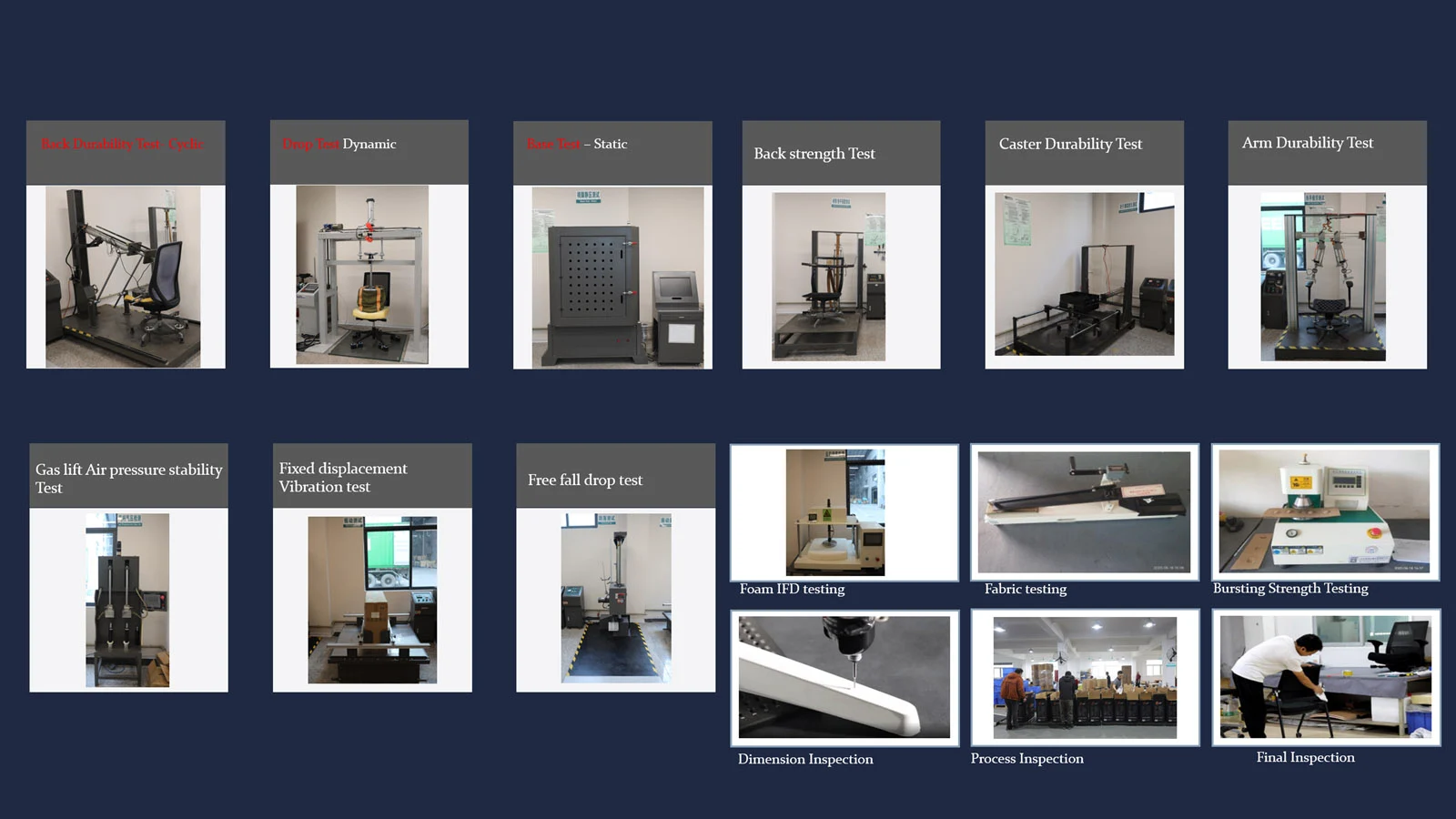
Review the report's product photos, model, construction, clauses, result, laboratory, accreditation, issue date, and change conditions. Contact the laboratory or use its verification system if available. A report for a different model, material, or construction should not be treated as automatic coverage.
Be cautious with generic ISO logos or claims. ISO 5970:1979, still repeated on some websites, is listed by ISO as withdrawn. Current requirements must be verified for the destination and tender.
065. Evaluate material control
Consistent finished products begin with controlled inputs. Ask how the supplier verifies tabletop panels, laminates, edge bands, steel tubes, plastic shells, powder, hardware, feet, and cartons.
Useful evidence may include purchase specifications, supplier records, incoming checks, material identification, thickness measurements, color control, and required material test reports. The level of traceability should match project risk and contractual requirements.
During an audit or video review, ask staff to select a material at random and show how it is identified against the order. A prepared display board alone does not demonstrate routine control.
076. Inspect cutting, welding, and frame preparation
For steel-framed desks and chairs, frame quality depends on accurate cutting and forming, stable fixtures, welding, cleanup, and surface preparation before coating.
Look for repeatable jigs, controlled dimensions, weld consistency, absence of hazardous sharp projections, and protection against contamination before coating. Ask how first pieces are checked when a model or setup changes.
Factory testing at this stage may include frame dimensions, diagonal alignment, hole position, and trial assembly. Catching an error before coating and final assembly is usually more efficient than sorting finished goods.
087. Review powder coating and surface finishing
A good-looking sample does not prove batch consistency. Confirm pretreatment, powder storage and identification, curing control, color comparison, film expectations if specified, appearance criteria, and handling after coating.
Agree how scratches, exposed areas, orange peel, color variation, contamination, and poor coverage will be classified during inspection. If corrosion resistance is required, state the test method and acceptance threshold rather than using “anti-rust” as an undefined claim.
For wood-based tops, check laminate bonding, edge adhesion, clean corners, surface defects, and protection from moisture during storage and shipping.
098. Check assembly, stability, and functional inspection
The quality team should be able to assemble sampled products using production parts and the customer instruction. Checks may include:
- Overall dimensions and levelness
- Rocking or instability on the defined test floor
- Fastener type, quantity, and tightening
- Chair shell and frame alignment
- Desk-top alignment and edge condition
- Adjustment operation at permitted settings
- Feet, caps, hooks, and accessories
- Cleanliness and surface appearance
Routine factory checks do not replace accredited testing when required, but they help ensure the shipped order remains consistent with the approved construction.
109. Assess change control and sample approval
Ask what happens when a specified material is unavailable or a component changes. The correct answer should involve documented customer review when the change affects the agreed product—not silent substitution.
Approve a pre-production or production sample with linked drawing, color, materials, and packaging. Keep a reference at the supplier and, where practical, one with the buyer or inspection party. Record deviations and approval conditions.
1110. Verify production capacity against the schedule
Capacity is not just factory floor area. Ask for the proposed production plan, critical processes, subcontracted steps, concurrent order load, inspection time, packing rate, and buffer before shipment.
Request milestone dates for material confirmation, first article, production, inspection, packing, and loading. Lead time should be stated from a defined trigger, such as deposit receipt and final specification approval. A promise of “fast delivery” without assumptions is difficult to manage.
KOHWA's website indicates a 10,000 m² production area and a team of more than 50. These figures can support an introduction, but buyers should verify current capacity and order-specific scheduling before relying on them.
1211. Examine packaging through a shipping-risk lens
Packaging must protect the product through handling, humidity changes, stacking, container movement, destination transport, and site storage. Ask for a packaging diagram or sample carton, not only “export standard packing.”
Check:
- Knock-down or assembled configuration
- Protection between coated metal parts
- Corner and edge protection for tabletops
- Hardware bags and part identification
- Moisture protection appropriate to the route
- Carton strength and closure
- Gross weight and safe manual handling
- Product, color, size, quantity, and room marks
- Pallet or no-pallet plan
- Container loading quantity and assumptions
Perform a trial assembly from packed parts. Efficient packing is not successful if components arrive scratched or installers cannot identify them.
Mid-article CTA — Request Supplier and Product Information Send KOHWA the models, quantity, destination, required dimensions, compliance documents, packaging needs, and target schedule. Ask for the catalog, technical discussion, sample options, and a quotation with clearly stated assumptions.
1312. Define a pre-shipment inspection plan
Do not wait until finished goods are ready to decide how they will be accepted. The purchase order or quality agreement should define inspection timing, sampling method, defect classes, acceptable quality limits if used, functional checks, measurements, documentation, and reinspection responsibility.
A typical school furniture shipment inspection can include:
- Quantity and order-status review
- Random carton selection according to the agreed method
- Model, color, size, and marking verification
- Workmanship and surface inspection
- Dimensional measurement
- Assembly of sampled units
- Stability and function checks
- Adjustment checks at relevant positions
- Packaging and drop/transport-related checks if specified
- Carton, pallet, and container-loading review
An independent third-party inspection can be valuable for high-value, remote, first-time, or tender-sensitive orders. The buyer should select the inspection scope and party according to risk.
1413. Review shipment documents and loading control
Before loading, align the commercial invoice, packing list, carton count, gross/net weight, volume, shipping marks, and booking information. Confirm whether certificates of origin, fumigation or pallet documents, product reports, or destination-specific paperwork are needed.
Loading records should show container condition, container number, seal number, loading sequence, carton condition, and final closure. Do not load visibly wet or damaged cartons without documented disposition. Retain records until delivery acceptance.
1514. Test communication and corrective-action behavior
Supplier quality is visible when a problem appears. During sample development, note whether the team identifies assumptions, answers technical questions, controls revisions, and reports delays early.
Ask for an example corrective-action format with confidential details removed. A useful response defines the problem, containment, root cause, corrective action, responsibility, deadline, and verification. Replacing a few items may be necessary, but it is not by itself a root-cause process.
Agree escalation contacts and response expectations before the order. Keep decisions in controlled documents rather than scattered messages.
1615. Clarify warranty, spare parts, and claims handling
The contract should define the warranty scope, start point, exclusions, evidence required, remedy, responsibility for freight or local labor, and claim timeline. Avoid relying on a warranty duration without reading the conditions.
Ask which parts can be replaced, how they are identified, and how long matching finishes are expected to remain available. Consider ordering a project-specific spare kit containing agreed wear or loss items such as feet, caps, and fasteners.
For transit claims, retain carton labels, batch references, photos before and after unpacking, quantities affected, and inspection records. A clear claim procedure helps both buyer and supplier respond faster.
17Supplier scorecard
| Area | Suggested weight | Evidence to review |
|---|---|---|
| Product and technical fit | 20% | Drawing, specification, sample, application match |
| Compliance and testing | 15% | Product-specific reports, laboratory verification |
| Manufacturing and process control | 15% | Process flow, first article, in-process records |
| Quality and inspection | 15% | Checklists, equipment, defect handling, shipment plan |
| Packaging and logistics | 10% | Pack specification, trial pack, loading plan |
| Capacity and delivery | 10% | Order-specific schedule and milestone control |
| Communication and change control | 10% | Revision discipline, response quality, escalation |
| Commercial and after-sales clarity | 5% | Quote assumptions, warranty, spares, claims process |
Adjust weights to the project. A tender with strict statutory requirements may assign a pass/fail gate to compliance before commercial scoring.
18Red flags that require clarification
- The supplier will not identify the exact product covered by a report
- Drawings, quotation, sample, and report show inconsistent construction
- Bank or contracting details change without a documented explanation
- “Any standard is available” but no relevant report can be reviewed
- Materials can be substituted without buyer approval
- Lead time has no defined starting point or production plan
- Packaging is described only as “export standard”
- Inspection is permitted only after full shipment payment or after loading
- Technical questions receive only sales slogans rather than measurable answers
- The supplier refuses reasonable independent inspection agreed before the order
A red flag is a reason to investigate, not automatic proof of misconduct. Record the response and decide based on evidence.
19FAQ
How can I verify whether a school furniture supplier is a manufacturer?
Review legal and contracting information, product-specific process knowledge, factory evidence, equipment and workflow, material records, production samples, and order-control documents. A site visit or live guided video can help, but the key question is whether the supplier transparently controls the manufacturing and quality responsibilities promised in the contract.
Which quality documents should I request?
Request the approved specification and drawing, sample record, relevant product-specific test reports, inspection plan, packaging specification, production or shipment inspection report, and required shipping documents. The exact set depends on the destination and tender.
Is a factory inspection the same as a product test report?
No. A factory inspection evaluates selected order characteristics and workmanship. A test report records results under a defined standard and method, often through a laboratory. Both may be useful, but one does not automatically replace the other.
When should pre-shipment inspection happen?
It should occur at an agreed stage when enough goods are completed and packed to provide a representative inspection, while there is still time to correct issues. Define this in the purchase order or quality agreement.
What should buyers send before asking for a quote?
Send product type, dimensions, materials, quantity, colors, destination, Incoterm, required standard and documents, customization, packaging, inspection expectation, and delivery date. Identify unknowns so the supplier can state alternatives.
Does KOHWA support OEM and ODM projects?
The current KOHWA website states support for color, size, material, branding, and packaging customization. Feasibility, minimum quantity, sample approval, testing implications, price, and lead time must be confirmed for each request.
20Conclusion
A dependable supplier evaluation combines commercial verification with product evidence. Control the specification, match reports to the quoted construction, review manufacturing and quality checkpoints, approve a sample, define shipment inspection, and clarify packing, documents, changes, warranty, and claims before production. This creates a fair basis for supplier comparison and a clearer path from quotation to classroom handover.
Final CTA — Contact KOHWA Planning a school, training center, campus, or institutional furniture project? Send your requirements, destination, quantity, drawings or reference images, required documents, and delivery target. Ask for the KOHWA product catalog, sample options, or a project quotation.
---
Editorial sources and review
This guide was prepared by the KOHWA Project Furniture Team and reviewed for product and export-procurement relevance. Standards must always be confirmed for the destination market and signed specification.
Frequently asked questions
Is a factory audit the same as a product inspection?
No. A factory audit evaluates the supplier's systems and capability. A product inspection evaluates selected order characteristics and workmanship against defined criteria.
When should pre-shipment inspection happen?
At an agreed stage when enough goods are complete and packed to form a representative sample, while there is still time to correct nonconformities.
What should be matched to a test report?
Match the model, dimensions, materials, frame construction, components, test method, standard edition, laboratory identity, dates and any limitations to the quoted product.
Ready to discuss your project?
Send the quantity, destination, student range and required documents. We will help clarify the next quotation step.
No fake urgency. Clear project information produces a clearer quote.